http://www.ted.com/talks/ami_klin_a_new_way_to_diagnose_autism.html
An interesting talk. I found some of it a little uncomfortable, but the message of the last 3 minutes or so is clear and concise - this is not a matter of 'curing' autism. Even early screening, diagnosis and intervention will not and should not necessarily do that. This is a matter of intervening early and making a change in children's lives, so that autistic individuals can grow up without such profound disabilities and isolation in certain areas. It's a controversial issue, because how much being autistic is a part of who you are is rightly contested - however if breakthroughs that Dr Klin is really only hinting at here could make a difference for the well-being and social engagement of individuals, then they are breakthroughs that are urgently needed. As he rightly pointed out, while autism currently has huge societal costs, autistic individuals can also give a great deal back - not only in their unique way of looking in the world - but in jobs and work we all expect of 'neurotypical' members of society. In a predictable and defined environment, as Dr Klin points out, they can be efficient and studious workers. Breakthroughs are needed so caregivers can begin helping children before they even reach those telling 'symptoms' that appear around the second year of age and can progress to engaged and happy members of the community.

10/06/2012
The DSM-5 - Stop Ignoring Mental Illness
My brand new article, hot off the press at The Periodical - a brilliant news/current affairs/columns/science-filled site owned, designed and filled by young people from across the country.
In the public eye mental illness is dramatized,
romanticised and sometimes even ostracised. All too often leaving people
shunned from society, disregarded and disrespected, mental illness is just one
more of the many reasons our press must be called into question. The problem,
in this case however, runs much deeper than our tabloids and online
bulletins. To call it a fundamental
misunderstanding would be incorrect, because even in the professional sphere,
where the greatest understanding is held, there is constant debate and
controversy over the status, description and diagnosis of mental disorders. At a time when the BBC has recently reported a
rise in depression and anxiety cases in young people (even extending to the
under fives) and the British Psychological Society (BPS) has reported a
significant jump in mental illness-related absence from work, found by the
manufacturers’ body EEF, it is certainly true that mental illness demands and
deserves a key focus in the public sphere. However, what recent months are
seeing is a turn away from the real illnesses and a rise in debate, bureaucracy
and factionalism.

Yet this, along with several other issues, is at the heart
of real controversy. The frightening truth is that this one book, published by
one association in America, is the difference between services or no services
for people across the globe. Parents of children with Asperger’s, for example,
are worried that this change in definition will mean their high-functioning and
high-achieving child may miss out on the help and support they require. The
editing of the DSM is designed to make psychiatrists’ jobs easier, and make
diagnosis more accurate and helpful – yet people are panicking over the
effects. While it is easy to say that health professionals have everyone’s best
intentions at heart, when you consider the effects of the economic greed
machine that is drugs companies and perhaps rather less cynically note the lack
of concrete visual evidence in so many mental disorders, you begin to think
that parents have every right, and indeed every need, to worry. There are so
many fine, or even dotted, lines so take into account – work by Baron-Cohen has
argued the nature of Asperger’s as an example of the ‘extreme male brain’; so
what is to stop every somewhat obsessive and shy man from being included in the
diagnosis?
Once the drafting phase began, criticism came thick and
fast, attacking all areas of the edits. According to ‘Psychology Today’,
disorders (like binge eating, minor cognitive disorder and the very
controversial ‘pre-psychotic risk syndrome’) were too common, leading to
unnecessary service use and grief for ‘neurotypical’ patients. According to the BPS, some edits (including
to ADHD, ‘delusional disorder’ and schizophrenia) encouraged
over-medicalisation of disorders where other forms of treatment could be
effective. Time Magazine noted the lack of distinction between clinical
depression and the standard grieving progress after bereavement. This issue,
like the issue with autism, has been discussed at great length in the press,
public and private homes. Extended grieving after bereavement is normal and not
usually treatable as such, yet bereavement can also lead to longer-term mental
health issues that need proper diagnosis and treatment.
Following the torrents of anger and confusion – both in
the professional and public domain, the American Psychiatric Association has
amended some of the areas under fire. Footnotes have been added to distinguish
between bereavement related depression and more conventional and unexplained
depression. Some debated disorders have even been removed from the upcoming
publication. Perhaps most importantly, the DSM-5 has been reopened for public
addition and comment. It is monumental that such a document, and one
traditionally relatively furtive and enclosed, has reacted to public opinion,
has listened to professional criticism and is changing accordingly.
But the issues are anything but neatly ironed out. The
worry remains for parents of affected children, the state of limbo remains for
patients on the debated and reforming edge of diagnosis and the anger will
remain for as long as the DSM appears to be economically driven, modernising
for the sake of it, or simply ‘out of touch’. The fields of psychiatry and
psychology depend so entirely and fairly exclusively on the DSM, and will
continue to do so in May 2013 when the DSM-5 is finally published. While these
fields are long entangled in controversy, confusion and frustration and are so
often portrayed to be failing their patients, they are services that have and
always will be incredibly important. They may not fix visible wounds, they may
not always categorise and define individuals as precisely as hoped and they certainly
fail to please all the parents, patients and public fora they encounter – but
they aim and so often succeed in helping those members of our community this ‘man-up-and-deal-with-it’
society entirely neglects. Amongst the exciting wait for the DSM, the factional
infighting and the furious debate, what this writer is really trying to portray
is this: for just a few short months psychiatry and psychology will get nothing
but bad press, but perhaps the underlying issue is that without such monumental
changes at the centre of mental health, mental illness would get no real press
at all.
You've read the whole article. Impressive! Now don't forget to support The Periodical.info and check out all the latest articles on everything from the monarchy to dubstep, diabetes to religion. Ooh and any problems/issues raised from this article? Leave a comment here or at the Periodical for some debate!
08/06/2012
Happy 50th Birthday NAS!
The National Autistic Society is celebrating its 50th anniversary this year! An amazing society, doing so much for people on the autistic spectrum, their families, carers and health professionals.
Fascinating timeline of their 50 ground-breaking years here:
http://www.tiki-toki.com/timeline/entry/21729/Our-story-so-far/#!date=1941-07-06_19:59:14!
Considering doing a '50 years' themed fundraising type thing in the summer, as suggested on the NAS website...with lots of '50' things. Perhaps get 50 people together...busk for 50 minutes...sell 50 cakes...walk 50 miles...comment any suggestions :)
Fascinating timeline of their 50 ground-breaking years here:
http://www.tiki-toki.com/timeline/entry/21729/Our-story-so-far/#!date=1941-07-06_19:59:14!
Considering doing a '50 years' themed fundraising type thing in the summer, as suggested on the NAS website...with lots of '50' things. Perhaps get 50 people together...busk for 50 minutes...sell 50 cakes...walk 50 miles...comment any suggestions :)
06/06/2012
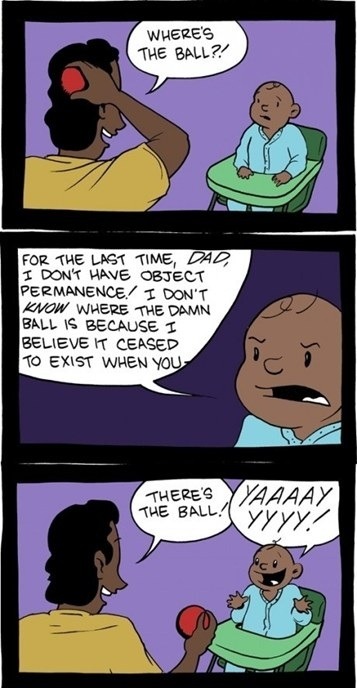
I KNOW ABOUT OBJECT PERMANENCE, DAD.
04/06/2012
Childcare, the flip side.
A week or two ago I posted a link to a BBC article with the revelation that childcare is too expensive. Well here's the flip side - apparently one in four childcare providers are making a loss. There's something seriously wrong here. I can't help but remark on the fact that on the BBC articles, the same three children are playing in the same water tray....the same children whose parents are struggling to pay their childcare and whose carers are struggling to live on the wage they receive. It's not right. But where's the solution?
http://www.bbc.co.uk/news/education-18300026
http://www.bbc.co.uk/news/education-18300026
30/05/2012
''The happiest days of your life''

Here, via the BPS (as usual) is a new report from the BBC on rising cases of anxiety and depression in children - right down to under 5s. It's almost shocking, almost unsurprising - but either way it's sad. While we're all so busy debating what diagnosis means, and why we should or shouldn't be giving mental-illness patients drugs...this report really begs the question why are we letting this continue, what are we going to do about it and when will we sit up and listen?
Childhood will never be easy. It's a time of physical and emotional development that naturally leads to confusion, discontent and volatility. Modern life doesn't make it any easier. But this is a real issue, happening now. While the news, and our minds focus on the depression should we not be worrying about the depression in our children...
(http://www.bbc.co.uk/news/uk-england-18251582)
28/05/2012
DSM-5 Update
Am currently attempting to research the DSM-5 (see below) in more detail. The APA DSM-5 has its own website, where you can find detail of all the disorders and amendments to be included in the revised edition as planned: http://www.dsm5.org/Pages/Default.aspx
Also, following my mention in my previous post, and due to my particular interest in autism and ASD, here are the specific revisions to the ASD diagnosis: http://www.dsm5.org/ProposedRevision/Pages/proposedrevision.aspx?rid=94#
Very interesting for me to see the actual language used in a book that, hopefully, I will use for the entirety of my professional life. Also, check out the 'Rationale' tab as it shows why the proposed changes are being made, and importantly the streamlining of the 'triad of impairments' . There is also a tab to compare the revision the the DSM-IV.
I am aware few people will be interested in this to the extent I am. However, these are significant changes being made to the diagnostic process of a hugely researched and yet little understood disorder which affects around 1 in 100 people. It's important. And it's interesting. Read up :)
Also, following my mention in my previous post, and due to my particular interest in autism and ASD, here are the specific revisions to the ASD diagnosis: http://www.dsm5.org/ProposedRevision/Pages/proposedrevision.aspx?rid=94#
Very interesting for me to see the actual language used in a book that, hopefully, I will use for the entirety of my professional life. Also, check out the 'Rationale' tab as it shows why the proposed changes are being made, and importantly the streamlining of the 'triad of impairments' . There is also a tab to compare the revision the the DSM-IV.
I am aware few people will be interested in this to the extent I am. However, these are significant changes being made to the diagnostic process of a hugely researched and yet little understood disorder which affects around 1 in 100 people. It's important. And it's interesting. Read up :)
26/05/2012
Vaccination - Safety, Science and The Social Contract.
Today I read an article in the BMJ (British Medical Journal) about whether childhood vaccines should be made mandatory. It's such a fascinating and important issue that I'd really love to do it justice with a full-blown article. However, a few thoughts will have to do for now.
The article was a for and against piece. Both mentioned standard examples - the notable decrease in coverage for the MMR jab after the reported (and quickly publicly, medically and completely rejected) link to childhood autism, and the subsequent rise in the spread of measles; the use of mandatory vaccination in America and the reasons that wide-spread vaccination is important. Neither side denied that - when you vaccinate your child, you're not just protecting your child, you are improving the nationwide coverage and helping development of herd immunity - the level of coverage of developed immunity at which those without protection are still at only negligible risk. This is what makes is a sociological issue and not just a medical one. It's not just a decision about health, and it's certainly not a private or personal decision - it's a decision for society as a whole.
Some other interesting points were raised. As an example of an alternative to making vaccination mandatory Australia was depicted. Financial incentives are used there for people who choose to vaccinate their children. However, those people declared as conscientious objectors are also given the incentives. I understand the arguments for preventing coercion, and that with regards to vaccination it's not those who understand and have publicly declared their objection that are the largest concern - it's those who don't know, don't care and so put their own children and those they come into contact with at significant risk. However, if incentives are given to those who haven't vaccinated their child, surely it is no longer a true incentive.
Points debated were whether making vaccination mandatory was necessary and whether it is a choice or public responsibility to vaccinate children. The significance of 'school entry' being the target age for compulsory jabs was also contested. One side argues that this is older than the age at which many diseases pose the greatest threat, and therefore defeats the point of having a vaccine. The other side argues that this is the age at which an un-vaccinated child becomes a risk to those around them.
It's a complex and moral issue, as well as a scientific one. I personally cannot help but think that herd immunity is such an important benefit to society that we should give up a little freedom of choice in order to achieve it. It's rather like Rousseau's Social Contract (1762) - we give up some of our personal freedom in order to fall into the protective clutches of an organised society. And as long as that society protects us and we can trust it, it's a sacrifice very much worth making.
 Postscript: I know I go on and on about it, but it's got to be said; this is an issue from a medical journal - it is at the very core of medicine and science and always will be. Yet it's also intensely social, moral, philosophical and psychological by nature - because it strays into areas of free will, free choice, freedom and liberty, protection of the young generation and where the government's role is in raising our own children. If psychology or sociology is denied the right to be a science, we are denying the relevance of real life in issues such as these. The effect of the MMR-autism issue reveals so clearly how science, belief and opinion can be so easily confused, to the detriment not only of science but of the people it affects. A vaccination is a chemical, but if only one person takes it - the effect is minimal.
I know not everyone will agree on the issues I've raised here, leave a comment - I'll be happy to reply.
The article was a for and against piece. Both mentioned standard examples - the notable decrease in coverage for the MMR jab after the reported (and quickly publicly, medically and completely rejected) link to childhood autism, and the subsequent rise in the spread of measles; the use of mandatory vaccination in America and the reasons that wide-spread vaccination is important. Neither side denied that - when you vaccinate your child, you're not just protecting your child, you are improving the nationwide coverage and helping development of herd immunity - the level of coverage of developed immunity at which those without protection are still at only negligible risk. This is what makes is a sociological issue and not just a medical one. It's not just a decision about health, and it's certainly not a private or personal decision - it's a decision for society as a whole.
Some other interesting points were raised. As an example of an alternative to making vaccination mandatory Australia was depicted. Financial incentives are used there for people who choose to vaccinate their children. However, those people declared as conscientious objectors are also given the incentives. I understand the arguments for preventing coercion, and that with regards to vaccination it's not those who understand and have publicly declared their objection that are the largest concern - it's those who don't know, don't care and so put their own children and those they come into contact with at significant risk. However, if incentives are given to those who haven't vaccinated their child, surely it is no longer a true incentive.
Points debated were whether making vaccination mandatory was necessary and whether it is a choice or public responsibility to vaccinate children. The significance of 'school entry' being the target age for compulsory jabs was also contested. One side argues that this is older than the age at which many diseases pose the greatest threat, and therefore defeats the point of having a vaccine. The other side argues that this is the age at which an un-vaccinated child becomes a risk to those around them.
It's a complex and moral issue, as well as a scientific one. I personally cannot help but think that herd immunity is such an important benefit to society that we should give up a little freedom of choice in order to achieve it. It's rather like Rousseau's Social Contract (1762) - we give up some of our personal freedom in order to fall into the protective clutches of an organised society. And as long as that society protects us and we can trust it, it's a sacrifice very much worth making.

I know not everyone will agree on the issues I've raised here, leave a comment - I'll be happy to reply.
22/05/2012
The DSM must tread carefully...
This is a momentous year. Aside from the Olympics coming to London, and the Queen's Jubilee, this is a big year for science, psychology and human kind. This year is the year that the DSM-5 comes into its final stages of drafting, writing, peer-review and then final publishing due in 2013. The DSM is the Diagnostic and Statistical Manual of Mental Disorders, and this will be the fifth edition. It's a big deal, because our understanding of mental disorders has increased dramatically since the DSM-IV was published in 1994. For example, previously separate disorders autistic disorder, Asperger's disorder, childhood disintegrative disorder and PDD-NOS will now all be under the diagnosis of 'autistic spectrum disorder'. While some worry this will 'leave people out' and lose the diagnosis parents sometimes have to battle for, it is a development very much in line with psychology and psychiatry and our understanding of autism as a whole.
 The DSM-5 has already attracted large amounts of controversy, before it is even published. The problem lies, as it so often does in the fields of psychology and psychiatry, in where the line between science and statistics, humanity and understanding is drawn. Psychology is largely not a study of particles, chemicals, empirical knowledge and tick-box answers (though all these things come in, as it is a scientific discipline) but instead a study of people. People are anomalous, individual and strange. Sure, symptoms can be measured and observed, categorised and defined - but the same feeling can make one man cry and another barely flinch, the same event can make one run to friends and another retreat to isolation, and, importantly, we all use language differently. Could one man's 'depression' be another's 'bad day, bad week, bad year'? Similarly, should we be diagnosing as mental illnesses such things that many people count as everyday life - is shyness an illness? What is an illness? These are philosophical issues, but ones important to such a fundamentally human science. The DSM has a job to do (Vaughan Bell's discussion of this was the inspiration for this entry) - it needs to make diagnosis distinct and clear, widely applicable and widely observable. It needs to be enabling rather than disabling, giving patients access to treatment, and crucially solutions. But the DSM also needs to stay faithful to the fact that psychiatry is a human science, and while certain illnesses demand certain drugs, treatments or allowances, there is no 'tick-box' for emotion, sensation, description and subjectivity.
I will forever stand by the scientific nature of psychology - though it is often looked down on, both by those in the more 'scientific' field of psychiatry and Joe Bloggs on the Street. I believe that Psychology is the most important science, because it is the science of us. Philosophy, drug development, chemistry, medicine and 'hard sciences' are all valid, necessary and true in many respects, but psychology does not deserve to be shelved next to homoeopathy or astrology. It's science; it's diagnostics, and most importantly, it's solutions. However, if psychology is bullied too far down the labelling road, and diagnostics forced to lie only in the observable and categorical - then this science will surely lose its relevance, importance and unique nature.
We must all be on our guard to defend our favourite science. We must all remember and appreciate the reality of mental illnesses - even those we cannot see. And just like the press, the researchers and Joe Bloggs on the street, the DSM must tread carefully.
Interested? Read Vaughan Bell's Article on the DSM-5: http://blogs.discovermagazine.com/crux/2012/05/22/what-is-the-bible-of-psychiatry-supposed-to-do-the-peculiar-challenges-of-an-uncertain-science/
Check out the DSM-5's very own website: http://www.dsm5.org/Pages/Default.aspx
And keep your eyes and ears peeled over the coming months!
The DSM-5 has already attracted large amounts of controversy, before it is even published. The problem lies, as it so often does in the fields of psychology and psychiatry, in where the line between science and statistics, humanity and understanding is drawn. Psychology is largely not a study of particles, chemicals, empirical knowledge and tick-box answers (though all these things come in, as it is a scientific discipline) but instead a study of people. People are anomalous, individual and strange. Sure, symptoms can be measured and observed, categorised and defined - but the same feeling can make one man cry and another barely flinch, the same event can make one run to friends and another retreat to isolation, and, importantly, we all use language differently. Could one man's 'depression' be another's 'bad day, bad week, bad year'? Similarly, should we be diagnosing as mental illnesses such things that many people count as everyday life - is shyness an illness? What is an illness? These are philosophical issues, but ones important to such a fundamentally human science. The DSM has a job to do (Vaughan Bell's discussion of this was the inspiration for this entry) - it needs to make diagnosis distinct and clear, widely applicable and widely observable. It needs to be enabling rather than disabling, giving patients access to treatment, and crucially solutions. But the DSM also needs to stay faithful to the fact that psychiatry is a human science, and while certain illnesses demand certain drugs, treatments or allowances, there is no 'tick-box' for emotion, sensation, description and subjectivity.I will forever stand by the scientific nature of psychology - though it is often looked down on, both by those in the more 'scientific' field of psychiatry and Joe Bloggs on the Street. I believe that Psychology is the most important science, because it is the science of us. Philosophy, drug development, chemistry, medicine and 'hard sciences' are all valid, necessary and true in many respects, but psychology does not deserve to be shelved next to homoeopathy or astrology. It's science; it's diagnostics, and most importantly, it's solutions. However, if psychology is bullied too far down the labelling road, and diagnostics forced to lie only in the observable and categorical - then this science will surely lose its relevance, importance and unique nature.
We must all be on our guard to defend our favourite science. We must all remember and appreciate the reality of mental illnesses - even those we cannot see. And just like the press, the researchers and Joe Bloggs on the street, the DSM must tread carefully.
Interested? Read Vaughan Bell's Article on the DSM-5: http://blogs.discovermagazine.com/crux/2012/05/22/what-is-the-bible-of-psychiatry-supposed-to-do-the-peculiar-challenges-of-an-uncertain-science/
Check out the DSM-5's very own website: http://www.dsm5.org/Pages/Default.aspx
And keep your eyes and ears peeled over the coming months!
21/05/2012
Childcare Costs, a revelation at last...
Funny that...I came to exactly this conclusion when I conducted a project on governmental provision of childcare for an essay competition last year. No, I didn't win...but I was ahead of the BBC!
http://www.bbc.co.uk/news/uk-18141076
http://www.bbc.co.uk/news/uk-18141076
Subscribe to:
Posts (Atom)